Educator | Communicator | Photographer

Category: #Sunnyside365 (Page 25 of 39)

#Sunnyside365 November 13, 2015

Sunnyside365_Day146

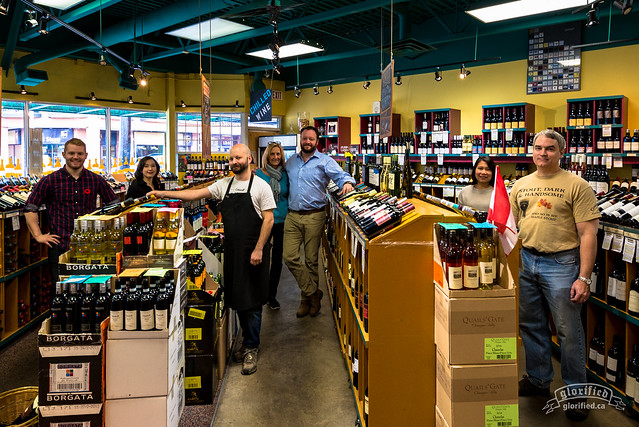
“There’s a nice sense of community that we love about this neighbourhood and that’s one of the things that drew us to starting our businesses here. It’s a little village. You can walk down the street and grab a coffee, grab some lunch, do some shopping, all in a four block radius.

We were one of the first privatized liquor stores in Canada.

We were named runner up for Whisky Retailer of the Year 2015, by Whisky Magazine in their “Icons of Whisky – Rest of the World Category” (excludes Scotland and the US). We took 2nd place behind “Berry Bros and Rudd”, which is a high honour considering BBR is also an independent bottler and owns the Glenrothes single malt brand. We are the only Canadian store to have been so considered, as we have been the last 3 years!

This is more than just a shop, there’s a lot of people who like to come in every couple of days that like to just chat with the staff because we’re local.” Andrew Ferguson, Owner, Kensington Wine Market

#Sunnyside365 November 12, 2015

Sunnyside365_Day145

“It’s a multi-disciplinary clinic. My focus has been a better quality of life for my patients, a lifelong quest for for better health. That’s where the name of the clinic comes from “Healthquest.” As soon as I graduated I opened this place. I have really been luck that my main team has been with me quite a long time. As of January it’ll be eleven years in this office.

We have five practitioners: myself as the chiropractor, one naturopath, and three massage therapists.

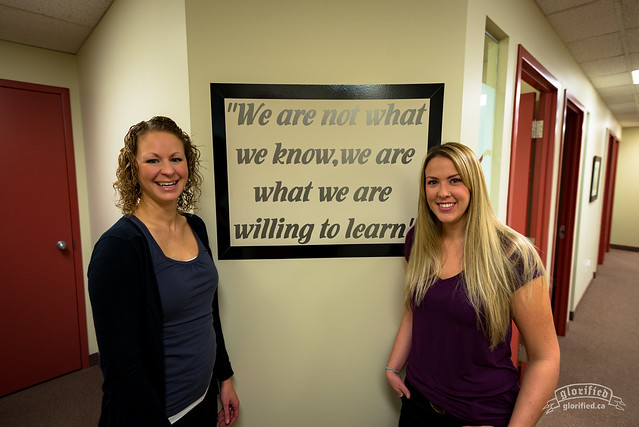
I love this neighbourhood. It feels like a small town in the middle of the city. The people here are always talking about how they mingle with their neighbours–for the businesses it’s the same thing. We all get to know each other. It’s also an active neighbourhood which is what I really love about it. Lots of walking, running paths, cyclists, that sort of thing. I treat patients from all over the city because everybody wants to come to Kensington.” Dr. Miranda Moen, left.

“I’ve been a massage therapist for about four and a half years. I’ve been in this clinic for about four of those years. I love the vibe of this neighbourhood. I love that there’s lots of shops and it’s a fun place to be.” Laura Dart, Massage Therapist, right.

#Sunnyside365 November 11, 2015

Sunnyside365_Day144

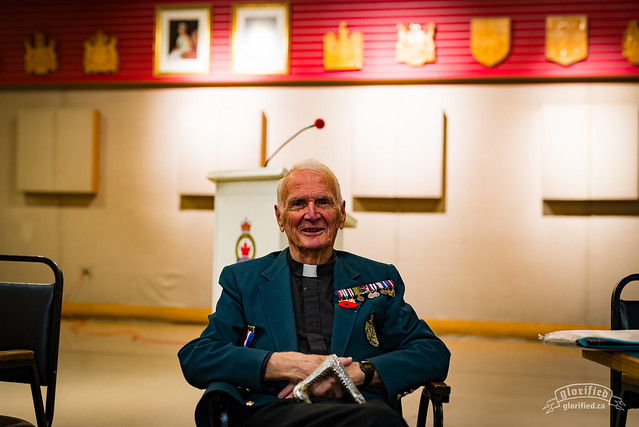
“I’m ninety-two years old. I like old people, that’s why I married my wife. She’s ninety-four years-old. We’ve been together for sixty-three years.

I joined up on August 6, 1942 and was discharged on October 8, 1945. I was a wireless operator with Lord Strathcona’s Horse, a Calgary tank regiment. I made 25 cents a day.

We trained in England for a year and on November 11, 1943 we went for service through Gibraltar. On the way there, part of our convoy was sunk. It was supposed to be a Military Hospital, but it ended up at the bottom of the sea. They put us up in Algiers for a while, and then sent us to Naples, Italy.
On my twenty-first birthday we took a train to Ancona and that’s where we met the war. After we liberated Italy, they sent us north to Holland.

Yes, this shrapnel is the nose of a 500 pound bomb that was dropped on us the day after probably the major battle of Italy in the Second World War for Canadians, which was the breakthrough of the Melfa River, when in one day we lost a third of our tanks and a third of our officers. A Victoria Cross, and a Distinguished Service Order and Distinguished Conduct Medal and several medals were given for that operation because we really broke through the German lines, which they didn’t expect to.

The Germans were such disarray that the next night they sent bombers over, and this is the nose of a bomb that dropped from probably 14,000 feet and landed 10 yards from our tank and the ground was hard that spring, very hard, like concrete and despite that, the bomb drop dug a crater six feet deep and probably 20 feet across, and missing our tank by probably 15, 20 yards, something like that.

As soon as the Rhine was crossed and the pontoon bridge built, we pushed our tanks across at Emmerich [am Rhein, Germany] and went back into Holland. Probably the most exciting battle, certainly in Holland, was Operation Dutch Cleanser [part of the Liberation of Arnhem, April 12-16, 1945], which was from Arnhem on the side of Nederrijn [river] to Zuiderzee [inlet of the North Sea], probably, oh, a 60, 70 kilometers maybe. And with the orders we were given, within 5th Division, was to get through at all possible costs. There was probably half a million German troops in western Holland, and also V-bomb [V-1 Rockets] bases which were bombing London. So as soon as we got across there, that would finish all that.

So we went so fast, we didn’t take any infantry and that’s very rare for tanks to go without infantry because you’re very vulnerable. A man could be sitting in a ditch with a bazooka and knock a tank out. We went so fast, we outran our food echelons. And the Dutch people, who were eating tulip bulbs that winter, fed us with putting eggs and milk into our tanks as we came down the road. And that really got to us. Dutch people were just fabulous. And when we got to Emmelo, which is a little town short of Harderwijk [Netherlands], and the heavy fighting before that, a lot of tanks knocked out, and all of a sudden, Jerry took off. And in the town square, we moved our tanks in and within minutes, there were probably a couple of thousand people.

I have pictures of girls climbing all over our tanks, you could hardly see the tank. And I got up in the turret and started the people singing, “Wilhelmus van Nassouwe ben ik, van Duitsen bloed,” which is the Dutch national anthem. And there wasn’t a dry eye to the place, 2,000 people. They hadn’t been able to sing for five years.

The education that many of us received that we never would have, had there not been a war, because we couldn’t afford it. Also, the tremendous bond of affection between Holland and Canada because of the liberation and the kindness of Dutch people who were eating tulip bulbs in the winter, and then feeding us with milk and eggs that spring when we came through. I am anti-gun. So we raised four children in our family, and I said to my wife, I said, “There will be no guns in this house.” And she said, “Well, you’re crazy, they’ll play with their guns with their friends at school.” I said, “That may be, but there will be no guns in this house.” So this is the line I have taken with going to different schools, that guns I don’t think accomplish anything. And so yeah, I was so highly trained, I could take a Bren gun apart with my blindfold, and we had to do that, and put it together again and all the other weapons too. But so I know where weapons are, I’ve been there, but I don’t think this is an answer, so I’m very anti-gun.

I suppose this probably had some influence on my later decision, somewhat later, to enter, to study for holy orders to be a priest. To see many men who were much better than I would be if I lived to be 100 killed, so it caused me to ask, you know, what is the purpose of my life. And not that you couldn’t have a purpose in life as a ditch digger or as an engineer or as a fireman or whatever, but I felt that my particular vocation here was to be a priest, m’hmm.” Father RHS Greene. A remarkable man, Father Greene, or ‘Padre’ as he likes to be called, still lives in his home in Sunnyside and visits the Kensington Legion to spend time with all the ‘young kids’–other seniors who are younger than him. 
#Sunnyside365 November 10, 2015

Sunnyside365_Day143

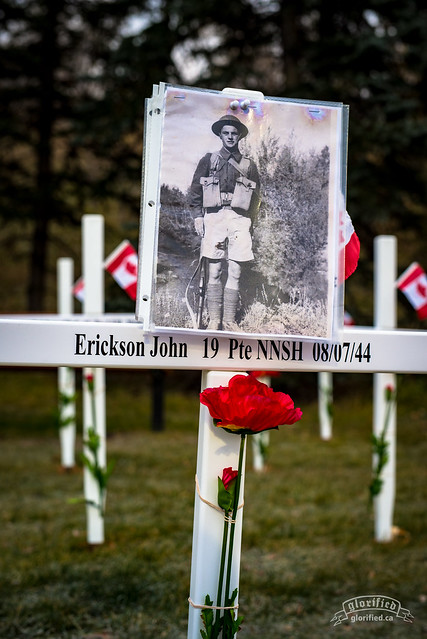
A note on this photo reads:

“JOHN WAS FROM CANMORE ALBERTA.

JOHN WAS RIDING IN ATRUCK AT THE REAR OF A SLOW MOVING TRUCK CONVOY. HE WAS ASKED TO DELIVER A NOTE TO THE LEAD TRUCK TO FIND OUT WHY THE CONVOY WAS MOVING SO SLOWLY.

HE JUMPED OFF THE BACK OF THE TRUCK AND WAS KILLED BY A LAND MINE.

HE WAS 19.”

#Sunnyside365 November 9, 2014

Sunnyside365_Day142

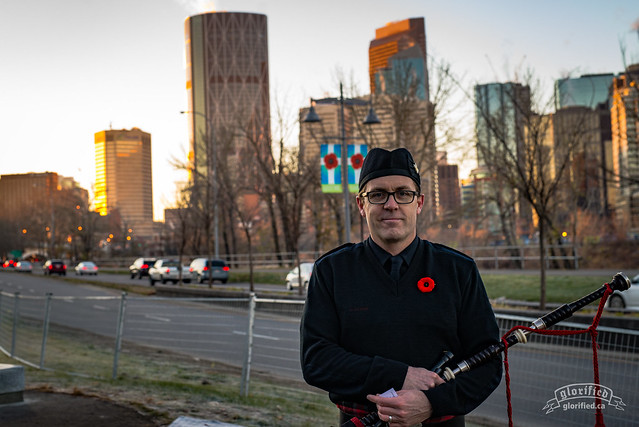
“Hi Ara,

I was the piper (who had a disastrous attempt at playing in the cold). Do you mind sending me a photo from the morning? It was my first time being at that ceremony, and I wouldn’t mind a photo.

I don’t mind you using my photo for whatever you need. I’m glad it doesn’t have sound as that was somewhat of a disaster. I’m a piper with the Alberta Firefighters Pipe Band (www.abfirefighterspipeband.com) and have been piping for about 4 years now (2 years with the band). Many members of our band participate in the Memorial project, and this was my first attempt.

I’m still learning how to play in very cold conditions! My favourite thing about Kensington is strolling down the main street and having a coffee at Higher Ground.

Cheers,

Steve “

#Sunnyside365 November 7, 2015

Sunnyside365_Day140

There’s something that keeps drawing me back to this memorial. Even though the crosses are symbolic–nobody is actually buried there–I find myself thinking about the far reaching effects of the World Wars. On April 24,1915 my ancestors were forcefully deported from their homes in what is now Eastern Turkey and became survivors of the Armenian Genocide. They fought for survival as they crossed the deserts into Iraq, Syria, Lebanon, and beyond–all casualties of a war that had spread all over Europe like an unstoppable brush fire.

Meanwhile, on the Western Front, the Battle of St. Julien (2nd Battle of Ypres) was underway, famous for being the first full-scale use of chemical weapons in the Great War. Countless Canadian troops gave up everything they had, ultimately to a loss of over 125’000 soldiers who ended up dead, wounded or missing in action from both sides of the conflict. It was at this place, during that month-long battle where Lieutenant-Colonel John McCrae had famously written his poem, “In Flanders Fields.”

When I was a child, we participated in Remembrance Day events. Being a first-generation Canadian, I never really understood the magnitude or impact that these wars had on my family. When people talk about how the soldiers at the time gave up their lives for our freedom, I never truly understood until I put in context of the Armenians massacred.

Now I know that if it weren’t for those Allied forces fighting so bravely, Armenians would have just been a memory in a history book.

Ara Shimoon

#Sunnyside365 November 6, 2015

Sunnyside365_Day139

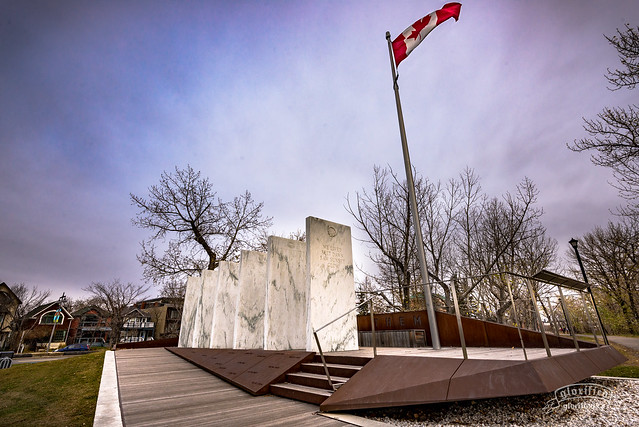
“The Calgary Soldier’s Memorial is part of a larger parks project along Memorial Drive called the ‘Landscape of Memory.’

The sculpture stands as a tribute to the sacrifice and service of soldiers serving with Calgary’s Army Reserve Regiments in the First and Second World Wars, as well as in the recent conflict in Afghanistan.

Six large upright marble slabs carry the names of over 3,000 soldiers who died while in service. They face the direction of Mewata Armoury a mustering point from which many Canadian soldiers departed to serve their country.

The Calgary Soldiers’ Memorial consists of several stone tablets bearing the names of soldiers from Calgary area regiments killed during times of war. These regiments include, in order of precedence, The King’s Own Calgary Regiment, 41 Combat Engineer Regiment, 746 (Calgary) Communications Squadron, The Calgary Highlanders, 14 (Calgary) Service Battalion and 15 Field Ambulance. Also represented on the tablets are those units of the Canadian Expeditionary Force perpetuated by the current Calgary units of the Canadian Forces, including the 10th Battalion, CEF and 50th Battalion, CEF.”

#Sunnyside365 November 5, 2015

Sunnyside365_Day138

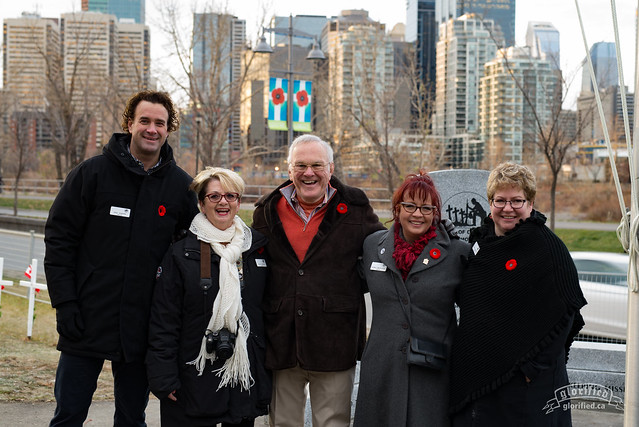
“The ‘Memorial Drive Crosses Project’ goes back ten years. My wife had passed away and I had been single for a while. Some time later I had met a lady from Georgia and was living in down there with her. One day, I was down there driving around and I saw these three crosses on a hill. I thought to myself that it might have been the site of an accident or something, but as I continued on I saw rows and rows of crosses. I had to pull over and walk among them. That’s when I saw they had names, ranks, date of death, and the age of the person on them. I was so overwhelmed that I began to cry. I suddenly had this intense feeling of the dead speaking to me from their graves saying, “We only wanted what you have. Remember us.” I came back to Calgary and started telling every one about this experience. I knew what I had to do.

We went to the City of Calgary and the Poppy Fund. We found this location and talked to the Parks organizations and they were all very supportive. This city has been fantastic with their support. The thing about working with veterans is that they don’t waste time. If you ask them for help for something, they get right to it. The support these guys have had for this memorial project is amazing. They pounded all the stakes and got the crosses up in no time. That’s the thing about military veterans. You never have to ask them twice.

A lot of the soldiers where buried were they fell, you know? This is the first time a lot of those soldiers have a marker for their graves. I had an uncle who served, but I was never in the service myself. I feel like it’s important to remember these guys and do something for them because they all gave so much.” J. Murray McCann (centre in photo) with some members the Field of Crosses Memorial Project.

#Sunnyside365 November 4, 2015

Sunnyside365_Day137

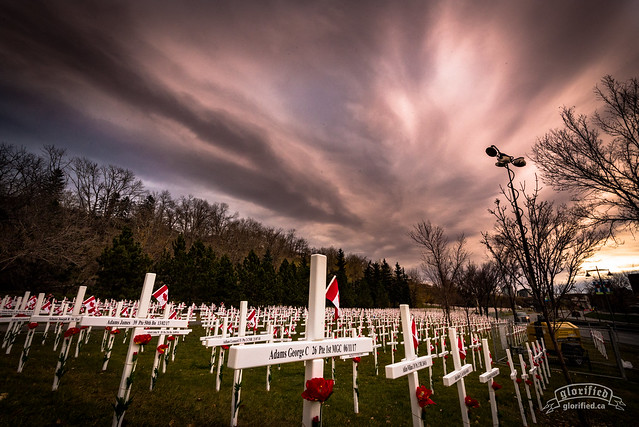
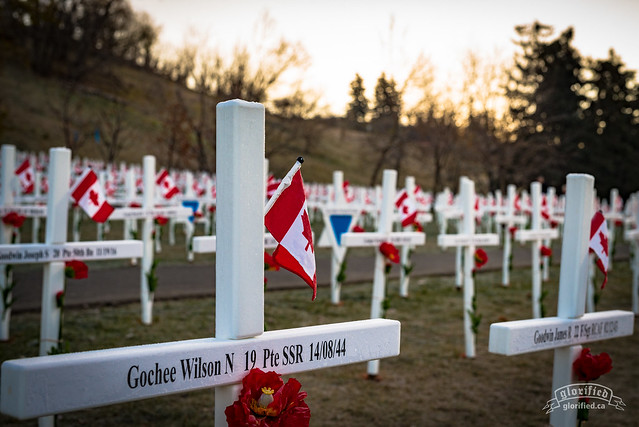
“There is a park reserved along Calgary’s Memorial Drive for 3,200 white crosses which are displayed each year on November 1st and removed November 12th. The date coincides with the Calgary Poppy Fund’s annual fundraising campaign and the Canadian Legacy Project’s Veterans Food Drive. Each cross is inscribed with the name, rank, regiment, date of death and age at death of a Southern Alberta soldier killed in action. It is estimated that more than 3,200 Southern Alberta soldiers have been killed in action. Veterans Affairs Canada keeps records of those who died, but not the hometown of the casualty; we welcome volunteers and input from friends and relatives who have lost a loved one from Southern Alberta who was killed in action and is not included in our Field of Crosses. Our wish is that no Southern Alberta soldier who paid the ultimate price for our freedom is ever forgotten.

At the going down of the sun, and in the morning, we will remember them…

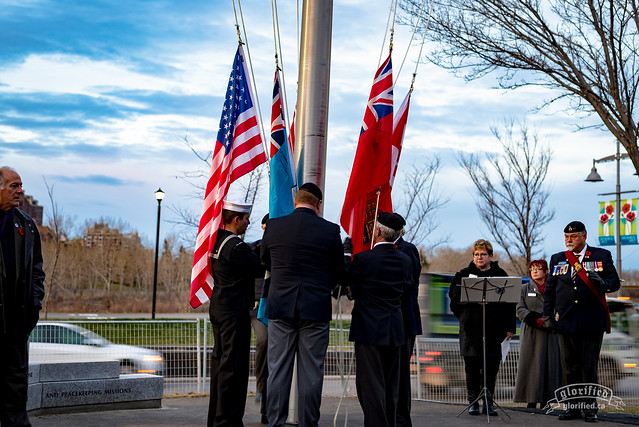
At sunrise each morning from November 1 to November 11 there is a flag raising ceremony at the Field of Crosses including a bugler and a piper. At sunset the flags are lowered.

Members of the public are welcome at these ceremonies or to visit the site at any time, to walk among the crosses, to lay flowers at a loved one’s memorial or to be reminded that the price of the freedom we enjoy was not free. Public parking is available at the west end of the park.

The memorial project is an initiative of the McCann Family Foundation in association with the Calgary Poppy Fund and numerous volunteers.” Field of Crosses Memorial Project, www.fieldofcrosses.com

« Older posts Newer posts »

© 2025 Ara Shimoon

Theme by Anders NorenUp ↑